In this guide
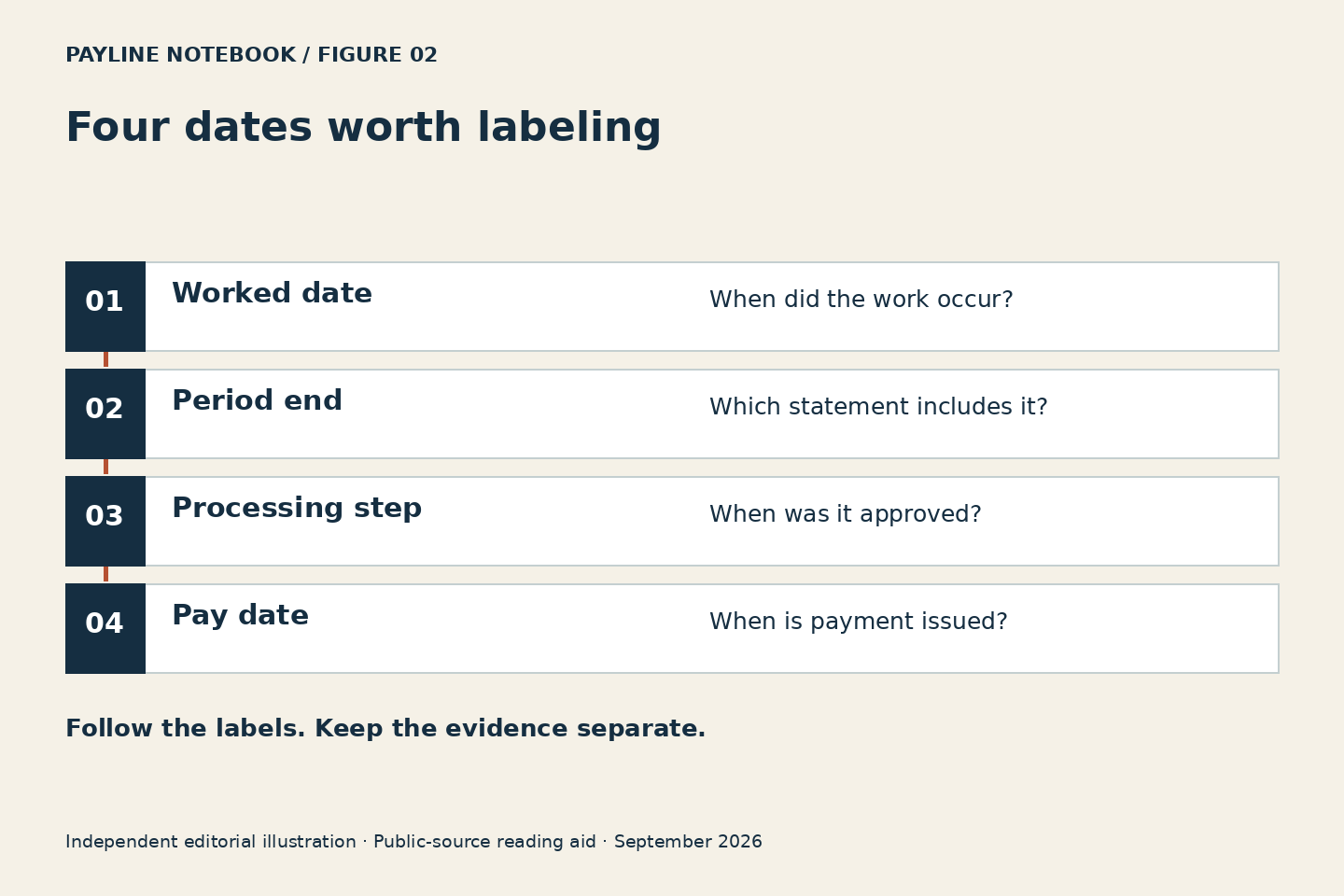
Avoid comparing dates that describe different events. The payment day, the earnings period and the workweek each answer a separate question.
The date beside the deposit
A pay date identifies a payment event. A pay period identifies the span represented by a statement. A workweek is a unit relevant to federal wage-and-hour calculations. They may overlap in convenient ways, but they are not synonyms. Write all three labels explicitly in a private comparison rather than calling every date “the week.” That small discipline prevents many apparent missing-pay puzzles.
Confirm the applicable calendar
The Northwell transition resource describes specific schedules for its audience. It should not be turned into a calendar for all Northwell workers. Obtain the current schedule for your employment group through the established workplace route. Ask which dates the statement covers and whether the date on a time record represents a worked day, approval day or processing day.
Two weeks and twice a month
Biweekly means a repeating two-week interval; semimonthly means two payments in a month. Those patterns do not describe the same calendar. Neither label tells you your own annual earnings, exact hours or deduction treatment. If you are comparing a monthly household expense with take-home pay, use the actual dated schedule and avoid casually converting one paycheck into “half a month.”
A shift crossing midnight
A night shift can touch two calendar dates. That does not authorize a reader to split or reclassify it in a particular payroll system. Ask how your timekeeping instructions record the shift and which applicable period receives it. Preserve the start and end information privately. If the displayed date seems surprising, establish the recording convention before treating it as an omitted shift.
A calendar comparison to practice
Imagine one schedule pays every other Friday and another lists two specified dates each month. Copying the first schedule into a “twice monthly” worksheet would erase the repeating fourteen-day pattern. Instead, write the actual dates in chronological order and mark the earnings period attached to each statement. For a shift that crosses the end of a period, leave its allocation unconfirmed until the timekeeping instructions explain it. This exercise compares calendar structures only; neither hypothetical schedule is asserted to be Northwell’s schedule for your position.
An editorial calendar exercise
Draw a strip showing the period start, period end, time-record deadline and pay date. Mark which of those facts came from an employer calendar and which remain unconfirmed. If a correction is discussed, place its proposed processing date on a separate strip. This makes it easier to ask whether the correction affects the original period, a later statement or both.
Use precise words in the handoff
Instead of saying “last Friday’s hours are missing,” identify the worked date and the statement period you inspected. Include whether the time record was approved, if you can verify that. Do not infer a processing cutoff from a coworker’s experience. The goal is an explanation of the particular dates in your case, with a source you can consult the next time.
Continue with Gross Pay and Net Pay: Build a Bridge Between the Numbers, or Shift Differentials, Holiday Pay and Overtime Are Different Questions.