In this guide
- What the public source establishes
- Give three records different jobs
- A worked reading sequence
- Read from the outside inward
- Turn surprise into a comparison
- Prepare a narrow question
- Know what closes the question
- Why the federal recordkeeping source helps
- Work the same discrepancy from three starting points
- Keep the expected outcome measurable
- Sources and scope
A paycheck question becomes manageable when you identify the record, period and line that changed. Start with evidence before deciding what caused the difference.
What the public source establishes
Northwell’s public new-practice transition page says paystubs are accessible through myExperience. That establishes a publicly described function; it does not give this publication access to your account. The same page contains arrangements for its transition audience. Do not borrow its pay dates or employee-group descriptions as a universal payroll calendar. Use the employer instructions that actually apply to your position and period.
Give three records different jobs
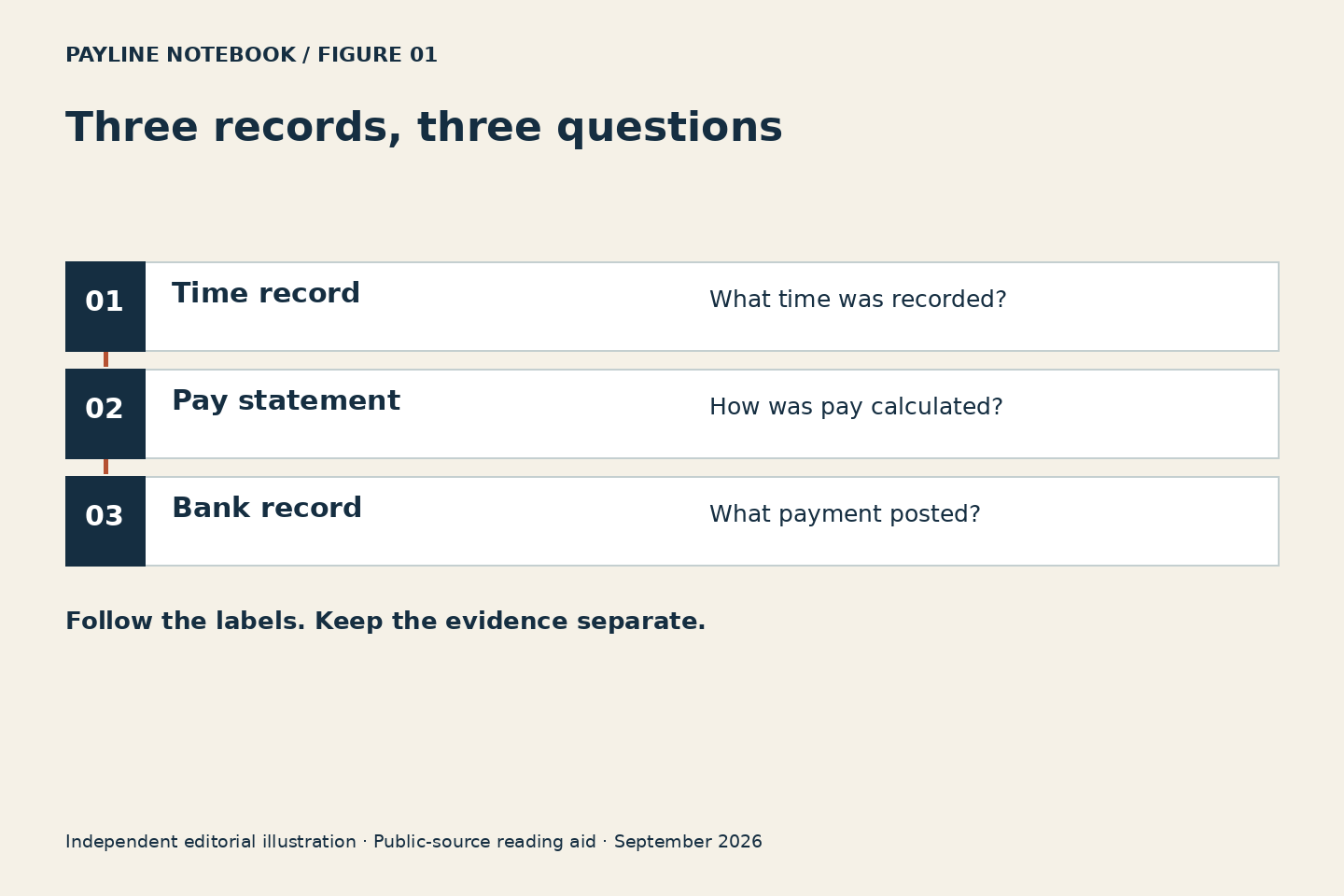
A time record describes recorded work or paid time. A pay statement describes earnings, deductions and the resulting payment for an identified period. A bank record describes money posted to an account. These can be related without being interchangeable. A deposit alone cannot explain an earnings code, and a statement alone cannot prove that a bank has posted a payment. Start by deciding which of those questions you have.
A worked reading sequence
Suppose two invented statements show gross earnings of $1,000 and $950, while the bank credits are $800 and $760. Start with the $50 earnings difference, then examine the deductions that turn each gross figure into net. Starting with the $40 deposit difference alone would hide part of the story. Your working note should identify both changes and the records that explain them. If the second statement’s net is $760 and the bank shows $760, the payment matches that statement; whether the statement itself is correct remains a separate question.
Read from the outside inward
First check the employer name, statement date and period covered. Then examine the earnings area, deductions and payment distribution. Keep current-period and year-to-date columns separate. If several statements were issued near one another, determine whether one is an adjustment or replacement before adding them together. The order matters: careful arithmetic on the wrong period still produces an unhelpful answer.
Turn surprise into a comparison
Imagine that take-home pay is lower than the prior statement. Compare gross earnings first. If gross is unchanged, compare deduction categories. If net is unchanged but the deposit differs, examine payment distribution and posting. This is an investigation sequence, not a diagnosis. A change can have more than one cause, and a label that looks familiar may need explanation from the payroll team.
Prepare a narrow question
A useful opening is: “For the period ending on this date, this line differs from the previous period. Which record explains the change?” Keep a private copy of the two statements and any related time record. Do not attach them to a public discussion or send them to this publication. Ask the verified payroll channel how it wants supporting records supplied.
Know what closes the question
A satisfactory answer identifies the line, the applicable period, the reason and any next action. If a correction is expected, ask where its completion will be visible. A response saying that the issue was received is not the same as a corrected statement or posted payment. Keep the original question open until the promised result can be checked against the relevant record.
Why the federal recordkeeping source helps
The Department of Labor’s recordkeeping fact sheet distinguishes information about worked time, the basis of pay, earnings, additions or deductions, the pay period and the payment date. That framework explains why a useful investigation needs more than the deposit amount. It does not mean every employer record listed in the fact sheet must appear on your paystub, and it does not establish the specific Northwell layout. Use the categories to formulate the question, then ask the employer which actual record supplies the missing information for your group.
Work the same discrepancy from three starting points
Imagine an employee in a hypothetical example notices a $40 smaller deposit. If the time record contains fewer approved units than expected, the first issue may be the recording or approval of time. If the time record is as expected but an earnings line differs, the issue shifts to how that record became pay. If the statement’s net is unchanged but one destination received less, the issue shifts to distribution or posting. These are branching investigations, not three accusations. Stop at the first unsupported connection and seek the evidence that resolves it.
Keep the expected outcome measurable
Before contacting anyone, write what would count as an answer. For an unknown code, the result is a definition and unit. For an amount discrepancy, it is an explanation tied to the relevant record or a documented correction. For a missing deposit, it is confirmation of issuance and the corresponding receiving-side status. A general reassurance may be welcome without satisfying that evidence need. This approach lets you acknowledge progress while keeping the unresolved portion visible, and it reduces the chance that repeated handoffs turn one precise issue into a vague account complaint.
Continue with Pay Date, Pay Period and Workweek: Three Different Clocks, or Compare a Time Record With a Pay Statement Without Double-Counting.