In this guide
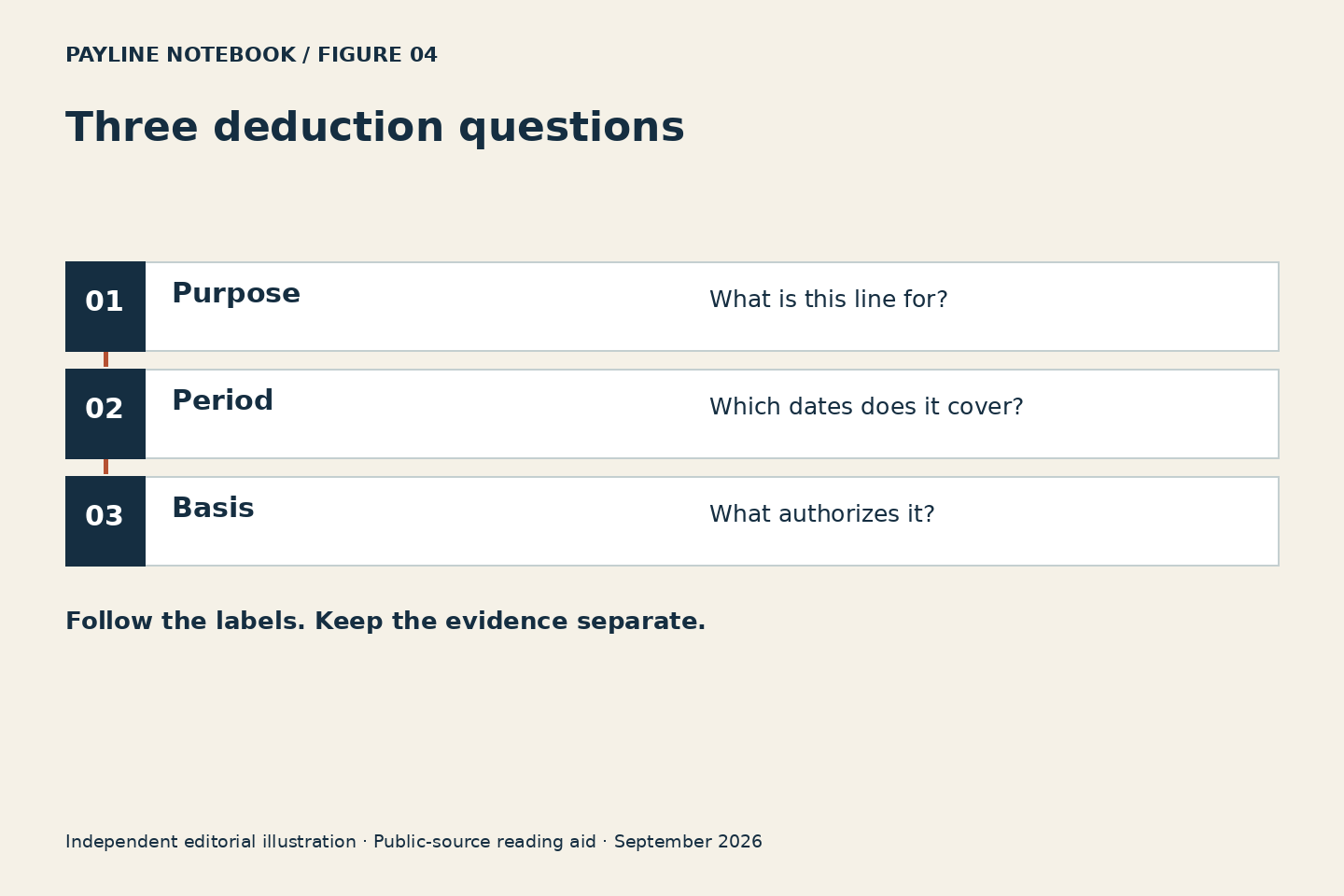
A deduction line needs more than a familiar name. Determine what it is for, which period it covers and why it is present.
Group without deciding tax treatment
Begin with broad reading categories: tax withholding, benefit-related deductions and other deductions or adjustments. These are organizing labels, not a tax classification. The same everyday description can conceal different treatment under different arrangements. Do not label something pre-tax or post-tax unless an applicable statement or authoritative explanation supports that conclusion for the particular line.
Compare current and cumulative amounts
A year-to-date column is cumulative within the scope of the statement. It is not the amount removed from this one payment. Read the column heading on every copied figure. If a current deduction changes, compare the same line across adjacent statements and note whether there was an effective-date change, a one-time adjustment or an unexplained difference.
A three-period pattern is a clue, not a conclusion
A hypothetical deduction appears as $20, $20 and $40 on three statements. Several explanations are possible, including a changed amount or an adjustment, but the pattern alone does not choose among them. Record the three dates and exact label, then ask which period and basis the $40 represents. Do not assume it is a duplicate, and do not assume it is correct because the code is familiar. Once explained, annotate the third period so that a later comparison does not repeatedly flag the same already-understood event.
Ask what period the deduction covers
The period for an earnings line and the period covered by a deduction may need separate explanation. Do not infer that every deduction represents precisely the days worked on that statement. Ask the responsible team to identify the coverage or obligation period and the method used. This can reveal whether you need a payroll explanation, a benefit-election record or another source.
Trace authorization carefully
A deduction may arise from an election, a required withholding, an agreement or another stated basis. An unfamiliar line warrants a question about that basis. Do not simply stop a payment arrangement or alter a tax form to compensate for a deduction you have not understood. Keep the issue specific and seek the applicable correction process through the verified employer channel.
Use a minimal query
An opening message can identify the statement period and line label, then ask for its purpose and calculation basis. It need not include a bank statement, complete tax return or family medical information. If the team needs more, ask for the approved secure route and supply only the relevant records. This publication has no facility for receiving payroll evidence.
Verify the answer against later records
If the explanation says a deduction is temporary, record the expected stopping condition without assuming a date. If it is corrected, verify the actual adjustment. Keep a distinction between an employer explanation of the payroll line and a tax adviser’s assessment of personal consequences. Understanding what happened is the first step; deciding what to change may require separate expertise.
Continue with What a W-4 Update Changes, and What It Does Not Prove, or Net Pay and Deposit Distribution: Reconcile the Final Step.