In this guide
- An adjustment is an event
- Keep three references together
- Read positive and negative lines
- Do not predict a correction amount
- Check the promised evidence
- Retain a concise resolution note
- Read a replacement pair as a pair
- Build a correction ledger with separate dates
- A complete hypothetical trail
- Separate resolution from downstream review
- Sources and scope
A correction should explain what changed and where the result appears. Build a small trail instead of replacing the old evidence.
An adjustment is an event
An adjustment may relate to an earlier earning, deduction or recording issue. It can appear on a later document, which makes period matching important. This guide does not describe a verified Northwell adjustment screen. Use the statement’s own labels and the employer explanation to identify the original period, the reason for the change and the document recording the result.
Keep three references together
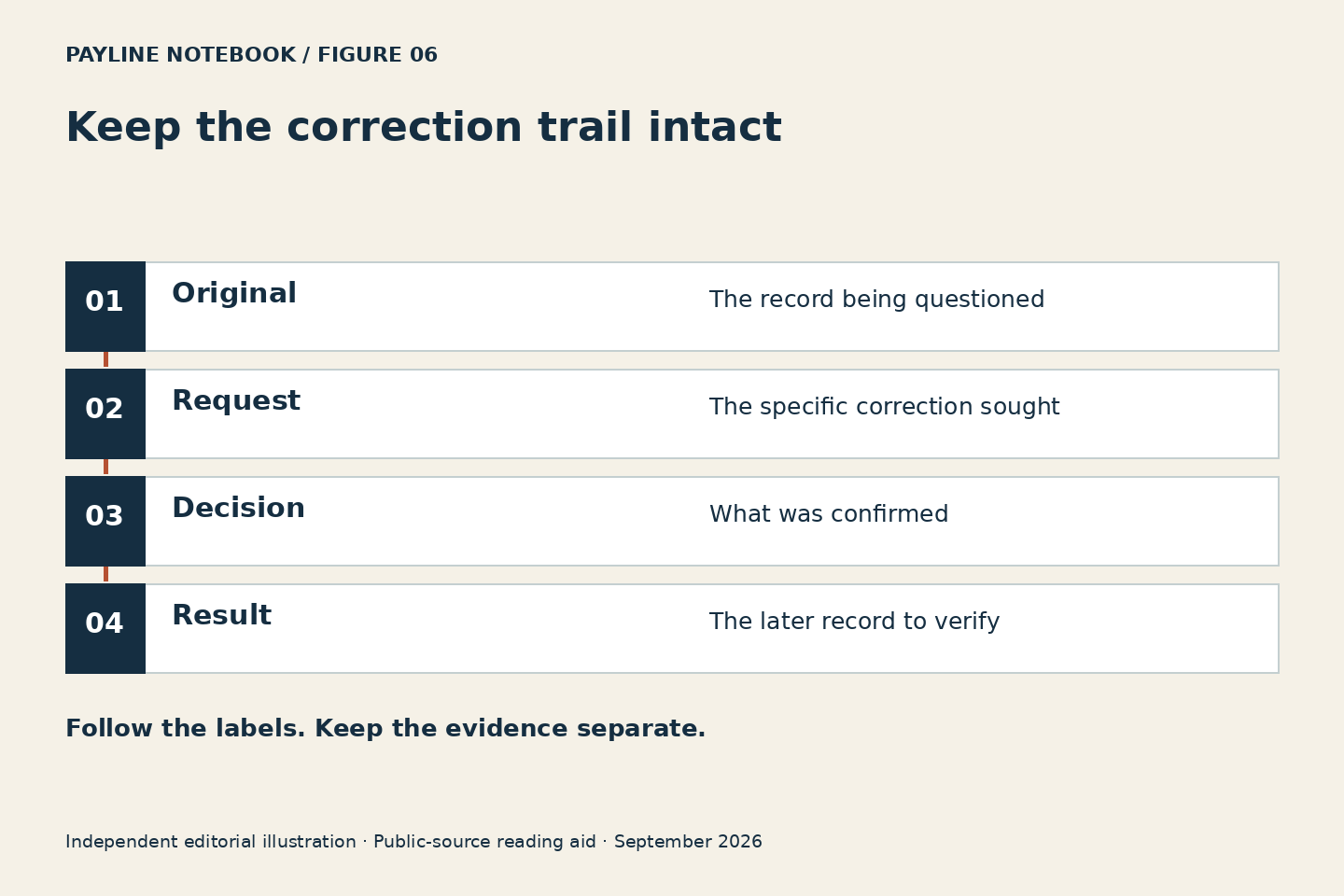
Retain a reference to the original record, the correction request and the resulting statement. A short private timeline can connect them without duplicating every attachment. Include the date submitted and any confirmation received. If the request changes, keep the revised scope clear. Otherwise it is easy to mistake a response to one issue for resolution of a different issue.
Read positive and negative lines
A reversal and replacement may both appear in a correction trail. Adding only the positive amount could overstate the net change; treating a negative line as a new loss could also mislead. Ask how the lines work together under the statement’s format. Preserve the signs and labels when copying figures, and distinguish gross adjustments from changes to final take-home pay.
Do not predict a correction amount
A request that concerns earnings may also affect other statement lines. This publication does not calculate a personalized back-pay or tax result. Ask the responsible team to explain the corrected components and applicable treatment. A rough private estimate can be labeled as your expectation, but it should never be presented as an official payroll determination.
Check the promised evidence
If the response says the correction will appear on a later statement, record the expected statement or processing stage. Then check that document when available. If the amount is distributed separately, seek the corresponding payment record. “Approved,” “processed” and “received” can be different milestones; use the exact milestone stated rather than assuming the final one.
Retain a concise resolution note
Write the original issue, the explanation, the correcting record and any remaining question. This helps if the same pattern appears again or an annual form raises a related question. Do not retain unnecessary private material indefinitely merely because a dispute once existed. Follow the recordkeeping requirements and advice applicable to your own circumstances.
Read a replacement pair as a pair
A fictional correction record might show a $40 reversal and a $100 replacement, producing a $60 change before any other affected components. Looking only at the positive row would describe the change incorrectly. Write the original reference, negative line, replacement line and resulting difference together. Then ask how the statement treats any related deductions or payment distribution. The example explains signed arithmetic only; it does not calculate back pay, tax treatment or the correct correction for a real employee. A later record should confirm the actual result.
Build a correction ledger with separate dates
A correction can involve at least four dates: the original work or event, the original statement, the request and the correcting record. Federal recordkeeping guidance provides context for preserving period and payment information, but it does not supply your employer’s correction workflow. Keep those dates in separate fields. If a response says an adjustment relates to an earlier period, do not change the correcting statement’s date to match the original one. Both dates are necessary to understand what happened and where the result should be visible.
A complete hypothetical trail
Consider a made-up issue affecting the period ending September 5. A question is submitted September 12, an authorized response confirms a correction September 16, and the employer says a later statement will show the result. Your note should retain all three confirmed dates and leave the final statement field pending until it exists. If the next available statement does not contain the expected item, the follow-up can name the original reference and ask whether the expected processing stage changed. Repeatedly submitting a new correction request could obscure the continuity of the existing case.
Separate resolution from downstream review
Once the correcting statement arrives, reconcile the specific lines and payment result. Then ask whether any related annual record or other statement requires separate review; do not assume either that everything changed automatically or that another action is always necessary. A correction can be resolved for one purpose while leaving a distinct question open. The final private note should identify the corrected component, the evidence checked and any remaining owner. It should not contain a blanket claim that all tax or legal consequences are settled by the payroll adjustment alone.
Continue with Reimbursement and Earnings: Similar Deposits, Different Questions, or Keep Payroll Evidence Out of Public Screenshots and Search Boxes.